
Alaska Dissolution of Marriage Records
Alaska dissolution of marriage records are kept by the Alaska Court System and are searchable through CourtView, a free public database available at courts.alaska.gov. These records cover both dissolution and divorce cases filed in Superior Courts across Alaska's four judicial districts. If you need the full case file, a copy of the decree, or a certified divorce certificate, you can find them through the court where the case was filed or through the Alaska Health Analytics and Vital Records Section. This page covers how to search, request copies, and understand what these records contain.
Alaska Dissolution of Marriage Overview
Dissolution of Marriage vs. Divorce in Alaska
Alaska has two ways to end a marriage legally. The state calls them dissolution and divorce. They are not the same thing, and the difference matters when you look for records. A dissolution is the simpler path. Both spouses must agree on every issue before filing. That means property, debt, child custody, support, and any other terms have to be settled. Then both sign the documents and file together. The case usually ends with one court appearance. The Alaska Court System Family Law Self-Help Center explains this process in full and offers forms, instructions, and a helpline.
Divorce, on the other hand, is for cases where the spouses cannot agree. One spouse files a complaint, and the other has 20 days to answer. If there is no answer, the person who filed can seek a default divorce, which generally takes two to three months. A contested divorce can take six months to a year or more if it goes to trial. Both dissolution and divorce end the marriage, divide marital property and debt, and when children are involved, both cases produce a parenting plan and a child support order.
Alaska also recognizes annulment, though it makes up less than one percent of all marriage terminations in the state. In 2022, Alaska recorded 2,208 legal separations. Divorces made up 56 percent of those, while dissolutions accounted for 44 percent. The Interior region had the highest separation rate in the state that year at 4.3 per 1,000 residents, according to data from the Alaska Health Analytics and Vital Records Section (HAVRS).
Records from both types of cases are filed at the Superior Court level. The court keeps the full case file. The state vital records office keeps a separate divorce certificate. You may need both depending on what you are trying to do with the records.
How to Search Alaska Dissolution of Marriage Records
CourtView is Alaska's online public access system for trial court cases. You can use it to look up dissolution of marriage and divorce cases statewide without visiting a courthouse. The system is free and available around the clock at courts.alaska.gov. You can search by case number, party name, or ticket and citation number.
Name searches work best when you try multiple spellings. If you are not sure how a name is spelled, start with the first few letters. For example, searching "Christ" will return results for Christensen, Christiansen, and Christianson. The system returns a maximum of 500 records per search. When searching for a business or organization, run three separate searches: once in the Company Name field, once in the Last Name field, and once in the First Name field using the same keyword.
Case number format matters on CourtView. Each number follows a pattern. The prefix tells you which district and court handled the case. For example, 3AN means Third Judicial District in Anchorage. 4FA means Fourth Judicial District in Fairbanks. 1JU means First Judicial District in Juneau. 2NO means Second Judicial District in Nome. The year comes next, then the sequence number, and finally the case type. Domestic relations cases filed before 1995 carry a DR suffix. Cases from 1995 forward use a CI suffix. If you are searching for older records, try both suffixes.
Public access terminals are available at every courthouse location across the state if you prefer to search in person. The system has no comprehensive records before 1990. Some records are removed from the public index under Alaska Administrative Rule 37.6. These include sealed cases, certain dismissed criminal cases, and some closed protective order cases. The CourtView information page has full guidance on how case statuses work and what each case number means.
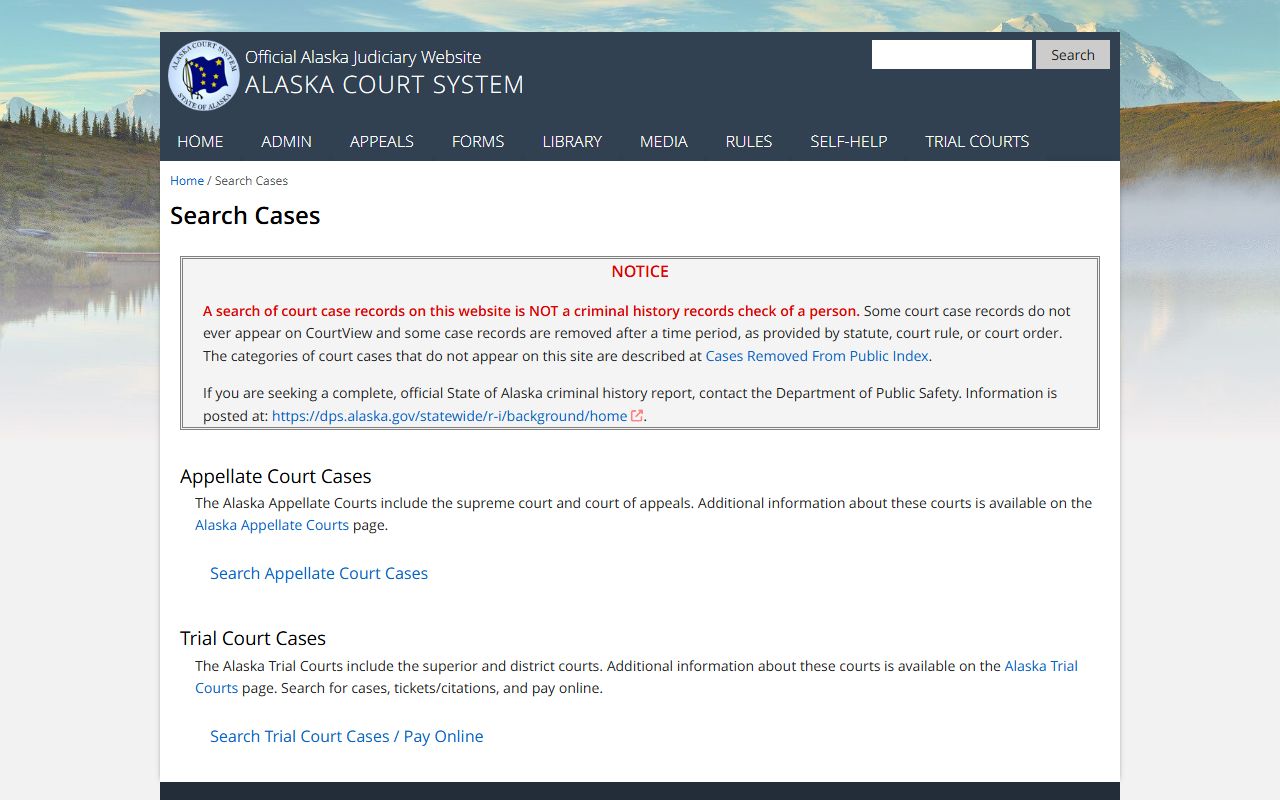
The screenshot above shows the Alaska Court System case search portal. You can reach CourtView from this page and run statewide searches for dissolution of marriage filings.
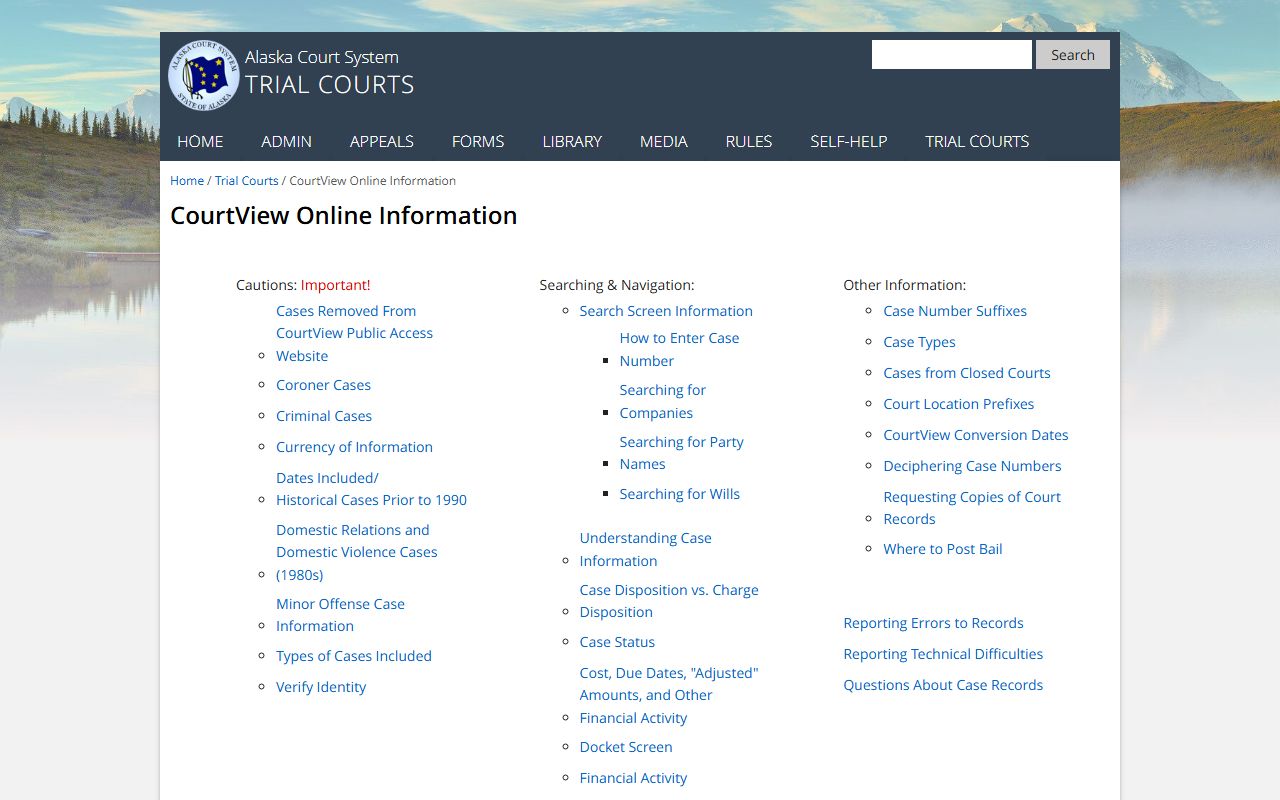
The CourtView information guide explains how to read case numbers, understand case statuses, and interpret search results for dissolution of marriage and other civil cases in Alaska.
Requesting Copies of Alaska Dissolution Records
Once you find a case, you can request copies of the documents in it. Each court location in Alaska has its own records request form. The form you need depends on where the case was filed. Anchorage uses form TF-311 ANCH. Fairbanks uses TF-311 FBKS. Palmer uses TF-311 PA. All other locations use the general TF-311 form. All of these are available at courts.alaska.gov/trialcourts/index.htm.
Fees are set by Alaska Court Rule 12(i). Plain copies cost $5 for the first document and $3 for each additional copy. Certified copies cost $10 for the first and $3 for each additional certified copy of the same document. If you do not provide a case number, the court charges a research fee of $30 per hour with a minimum of one hour. Processing time for standard requests is 5 to 7 business days. Large or complex requests may take longer.
For Anchorage, send requests to 3ANRecordsRequest@akcourts.us or fax (907) 264-0610. For Palmer, use 3PACopyRequests@akcourts.us or fax (907) 746-8152. For Fairbanks, use 4FARecordsRequest@akcourts.us. You can also pay for copies online by credit card. The court will email an invoice with instructions. You can also pay in person by cash, check, or money order, or by mail using a check or money order.
Documents you can request from a dissolution case file include the petition or complaint, the decree of dissolution or divorce, qualified domestic relations orders (QDROs), satisfaction of judgment, motions, orders, and the full set of documents in the file.
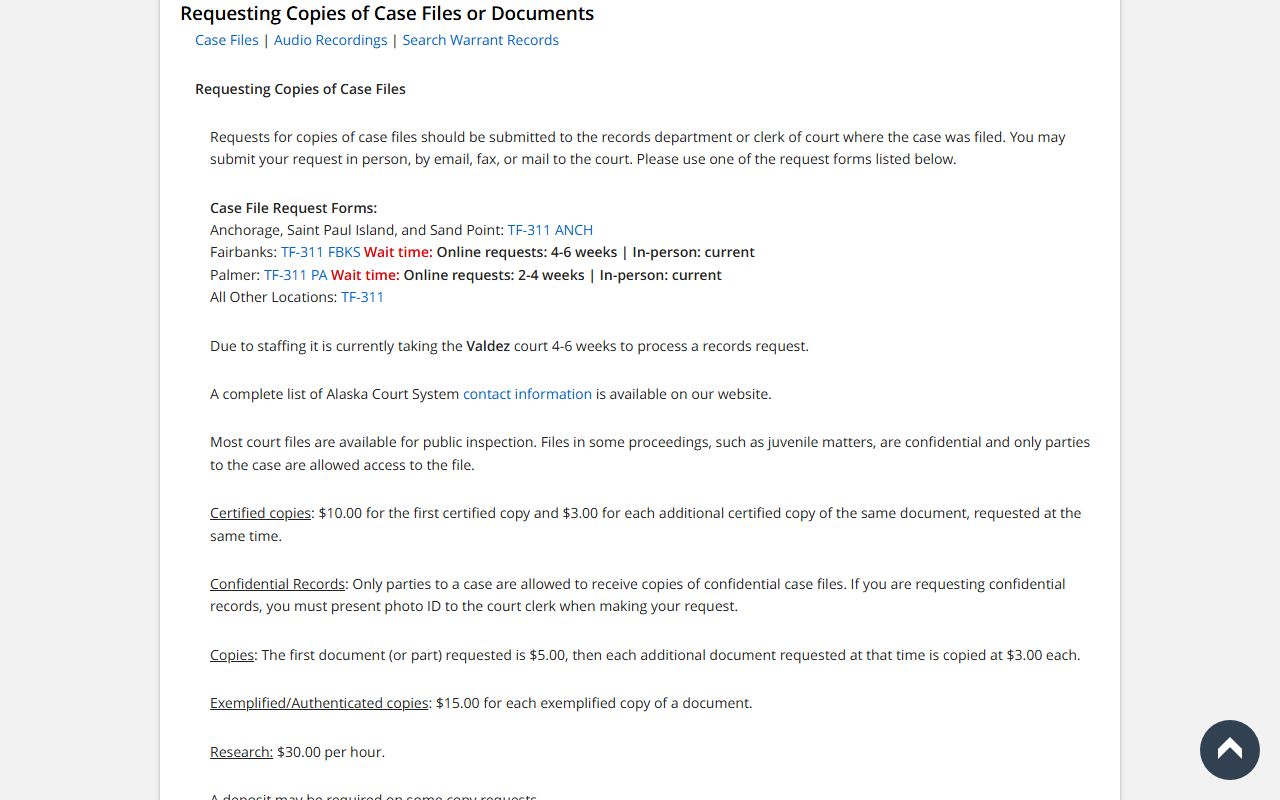
The Alaska Court System records request page has location-specific forms, contact information, and detailed fee schedules for requesting dissolution of marriage documents from any court in the state.
Alaska Divorce Certificates from Vital Records
The Alaska Health Analytics and Vital Records Section, also known as the Bureau of Vital Statistics (BVS), keeps a separate set of records called divorce certificates. These are different from the court decree. A court decree is the full legal order. A divorce certificate is an official summary record of the event. Divorce certificates are available from 1950 through the present. For records prior to 1950, contact the Clerk of the Superior Court in the judicial district where the divorce was granted. The state office at the vital records orders page also has some records going back to 1913, but coverage before 1950 is limited.
Divorce certificates are used to prove marital status for remarriage, name changes, passport applications, and insurance or pension benefit eligibility. A copy of a divorce certificate costs $30 for the first and $25 for each additional copy ordered at the same time. You can order through VitalChek online, by mail, by fax, or in person at the Juneau or Anchorage offices.
The Juneau office is at 5441 Commercial Boulevard, Juneau, AK 99801, phone (907) 465-3391. The Anchorage office is at 3901 Old Seward Highway, Suite 101, Anchorage, AK 99503, phone (907) 269-0991. Mail requests go to P.O. Box 110675, Juneau, AK 99811-0675. Fax requests to (907) 465-3618. VitalChek orders take 2 to 3 weeks. Mail and fax orders take 2 to 3 months. All requests must include a copy of a government-issued photo ID. Acceptable forms include a driver's license, state ID card, passport, military ID, or Tribal and BIA card with photo. During the 50-year privacy period after the date of the event, only parties named on the record or their legal representatives may obtain copies.
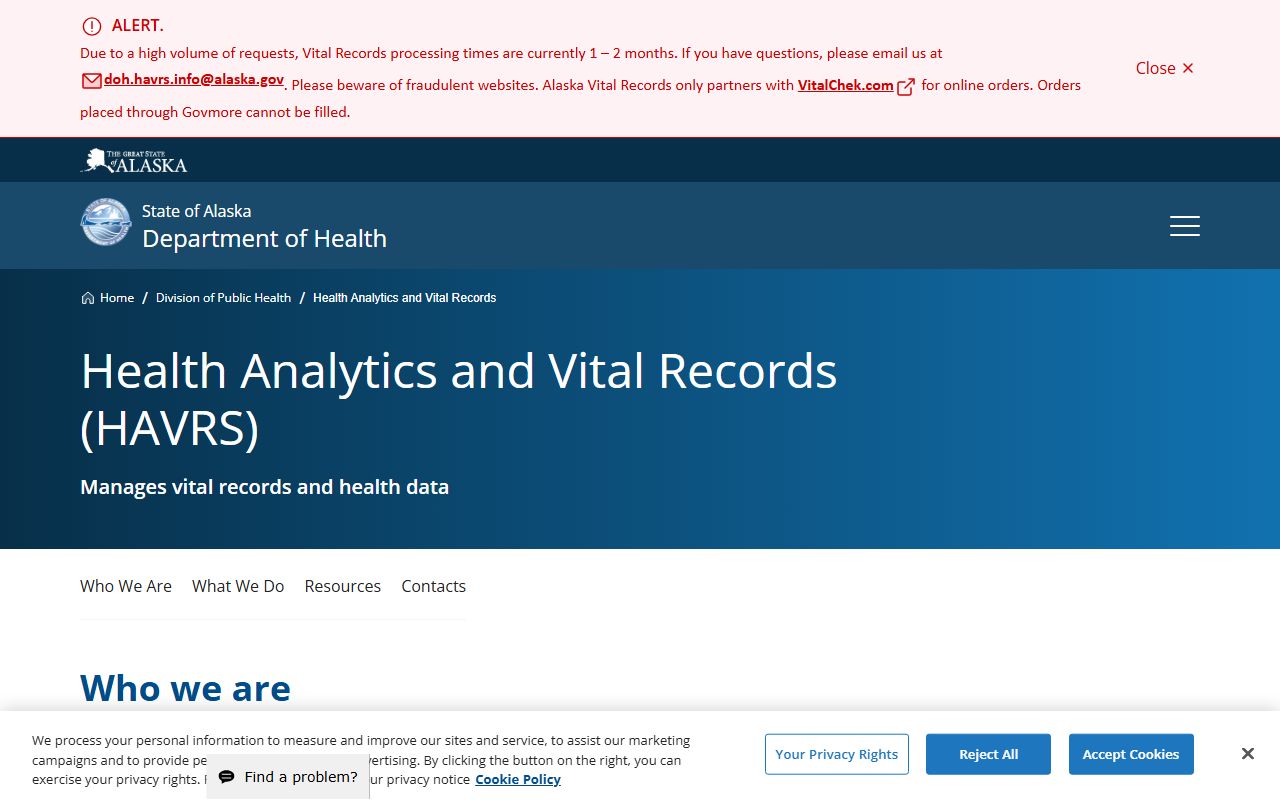
The Alaska Department of Health vital records page covers how to order divorce certificates, what ID is required, how much it costs, and the processing times for each ordering method.
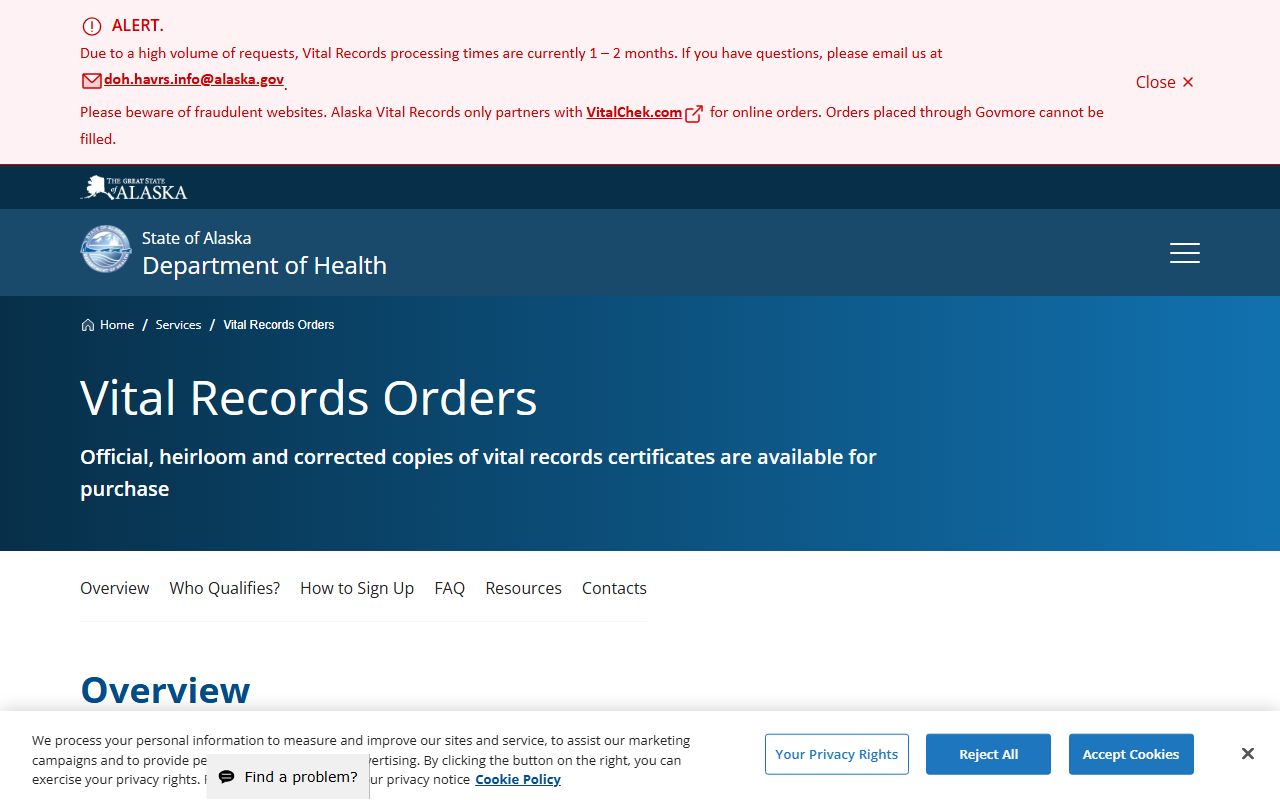
The Health Analytics and Vital Records Section manages Alaska's divorce certificate database through the state's Electronic Vital Records System, which covers divorces, dissolutions, and annulments from 1950 to the present.
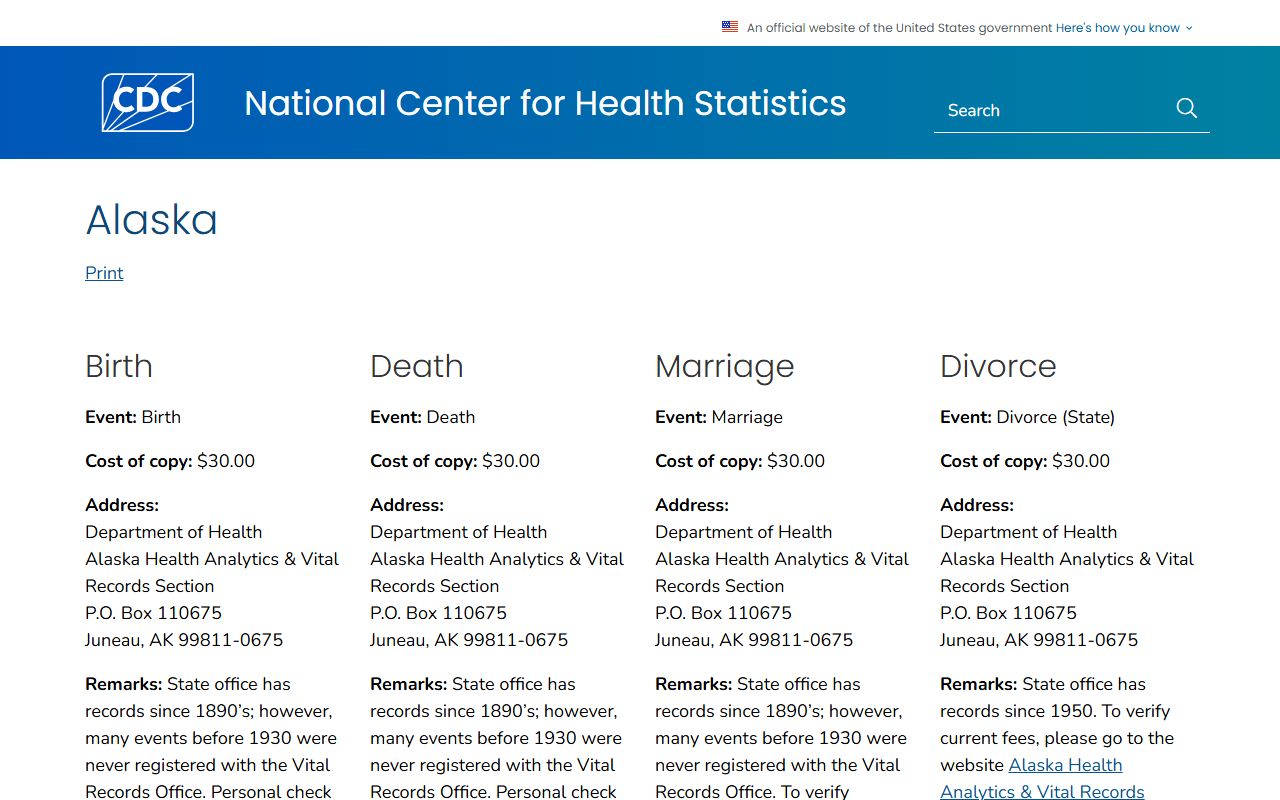
The CDC where-to-write guide for Alaska provides a federally maintained reference for how and where to request divorce records, including fees and mailing addresses that are kept current by the National Center for Health Statistics.
Alaska Dissolution of Marriage Forms
The Alaska Court System provides complete form packets for dissolution and divorce. The forms you need depend on your situation. All packets are available as fillable PDFs at courts.alaska.gov/forms/index.htm. Printed copies are also available at all courthouse locations.
The main dissolution packets are DR-1 for two spouses with children, DR-2 for two spouses without children, and DR-3 for cases where one spouse cannot be located. Divorce packets include DR-4 for uncontested divorce with minor children, DR-5 for uncontested divorce without children, and DR-6 for cases with no property, no children, and a short marriage. Each packet has a cover sheet, instructions, and all the forms you need to file.
Form VS-401, the Certificate of Divorce, Dissolution, or Annulment, must be included in every case. This form goes to HAVRS so the state can record the dissolution. If VS-401 is not filed, parties may not be able to remarry, apply for a new marriage license, or receive benefits tied to marital status. The form must be filled out in black ink with no cross-outs or corrections. Boxes 9 through 32 require the parties' personal information.
Other useful forms include DR-255 for property and debt statements, DR-305 for child support guidelines, DR-475 for parenting plans, and DR-956 for name change requests in a divorce case. Modification requests use form DR-130.
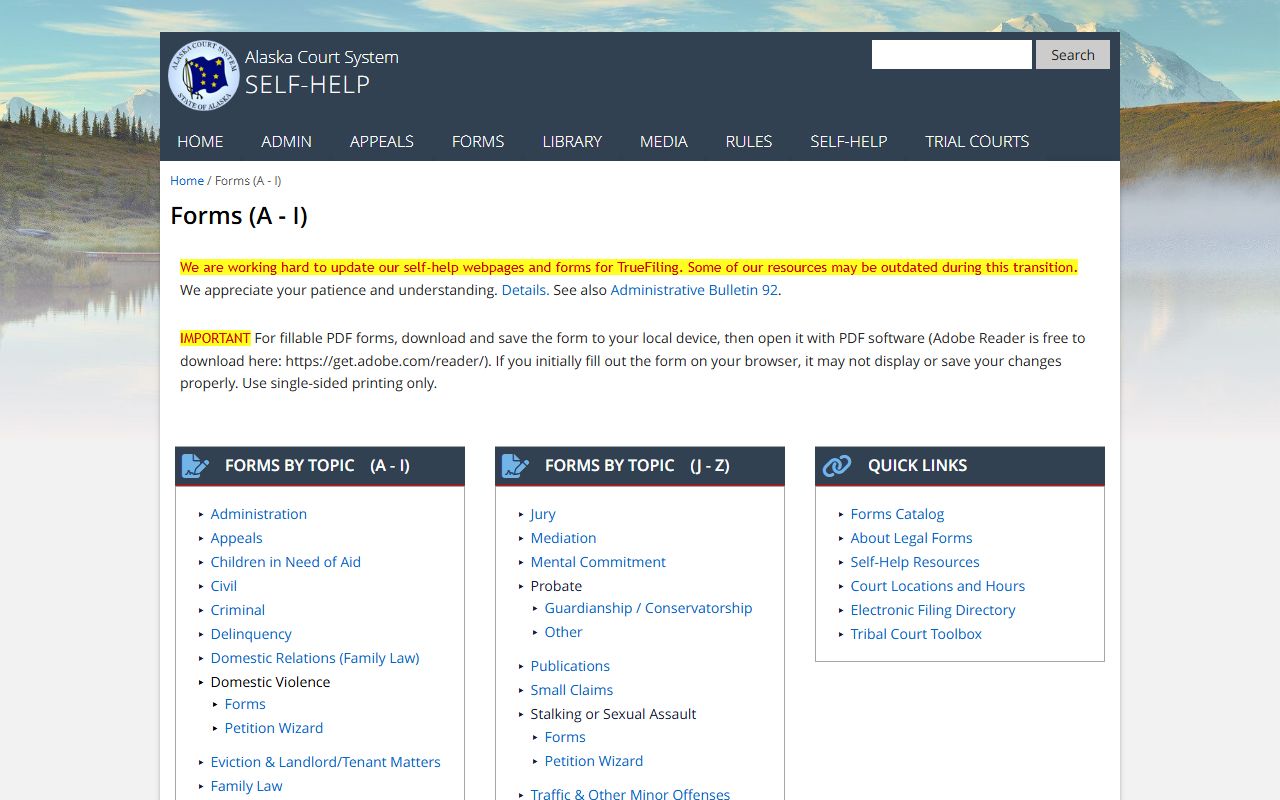
The Alaska Court System forms page organizes all dissolution and divorce forms by topic and provides fillable PDFs for every packet type, from simple no-children dissolutions to contested divorces with complex property issues.
Alaska Dissolution Laws and Residency Rules
Alaska law on dissolution and divorce is found in Alaska Statutes Title 25, Chapter 24. This chapter covers the right to file, grounds, custody, property division, and modification of orders. Understanding the basics helps when reading records or searching for a case.
Under AS 25.24.090, one spouse must be an Alaska resident at the time of filing for the court to have jurisdiction. Military personnel stationed in Alaska for 30 or more days qualify as residents. No separation period is required before filing. After filing, there is a mandatory 30-day waiting period before the judge can sign the final decree. In most courts, parents with children must also complete a parent education requirement before the dissolution can be finalized.
Alaska is primarily a no-fault state. Most dissolutions and divorces are granted on the ground of incompatibility of temperament, which is listed in AS 25.24.050. Fault grounds also exist. They include failure to consummate the marriage, adultery, felony conviction, willful desertion for one year, cruel and inhuman treatment, habitual gross drunkenness for one year, incurable mental illness with 18 months of confinement, and drug addiction. Most people file on no-fault grounds. The Alaska Bar Association has plain-language guides explaining these options.
AS 25.24.200 governs dissolution specifically. It requires that both parties agree on all issues before filing. AS 25.24.150 covers custody, which is decided using the best interests of the child standard. AS 25.24.165 allows either party to restore a former name as part of the decree. AS 25.24.170 allows modification of judgments when there has been a substantial change in circumstances.
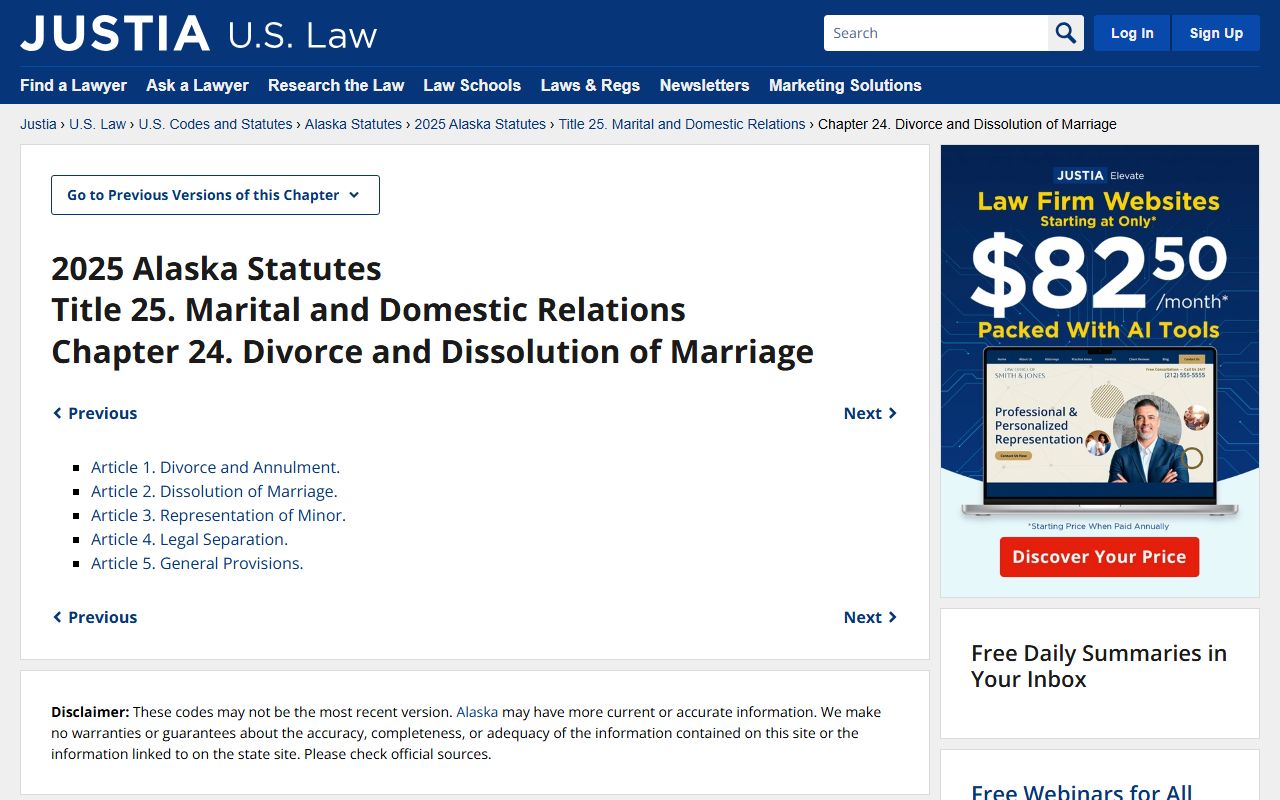
Justia's Alaska Statutes page has the full text of Title 25, Chapter 24, covering all the laws that govern dissolution of marriage and divorce in Alaska, including AS 25.24.200 on dissolution and AS 25.24.050 on grounds.
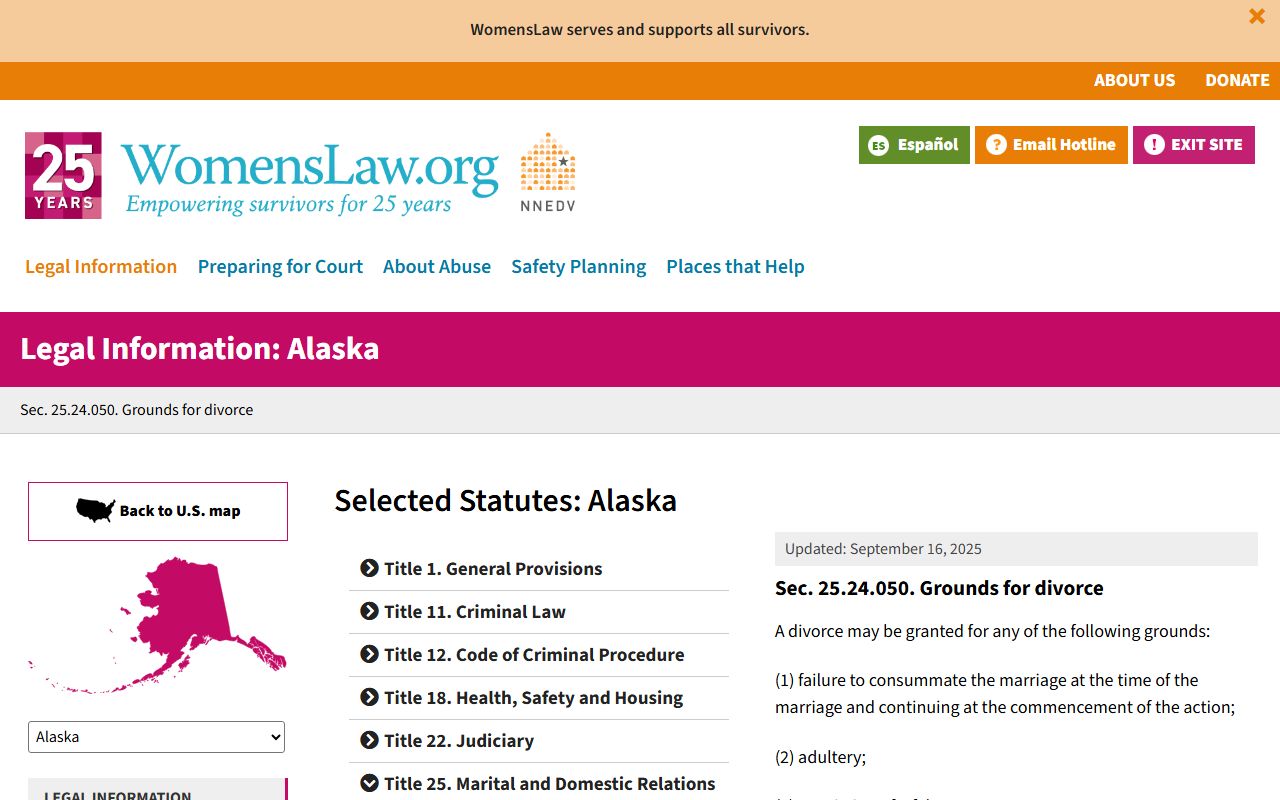
The WomensLaw guide to AS 25.24.050 explains the complete list of grounds for divorce in Alaska in plain language, useful when reading older dissolution records that may reference fault-based grounds.
Are Alaska Dissolution Records Public
Yes. Court records in Alaska are generally public. Access is governed by Alaska Court Rule 37.5 and AS 40.25.110-120. You do not need to be a party to the case. You do not need to explain why you want the records. Most documents in a dissolution or divorce case file are open to anyone who asks at the courthouse or submits a proper request form.
Some records have limits. Financial documents like detailed asset statements may be sealed in some cases. Social security numbers and account numbers are redacted from public filings. Records involving minors, including custody evaluations, may have restricted access. A party can ask the court to seal records by showing good cause, but courts do not grant these requests routinely.
Divorce certificates from HAVRS carry a 50-year privacy restriction. During that period, only the parties named on the record or their legal representatives can get a certified copy. Birth records become public after 100 years. After the privacy period ends, divorce certificates are open to anyone.
Historical records before 1950 are held by the Clerk of the Superior Court in the judicial district where the divorce was granted. The FamilySearch guide to Alaska vital records covers how genealogical researchers can access older dissolution and divorce records, including what is at the Alaska State Archives and the National Archives Alaska Region. The SSA Program Operations Manual also has guidance on Alaska divorce records for federal benefit purposes.
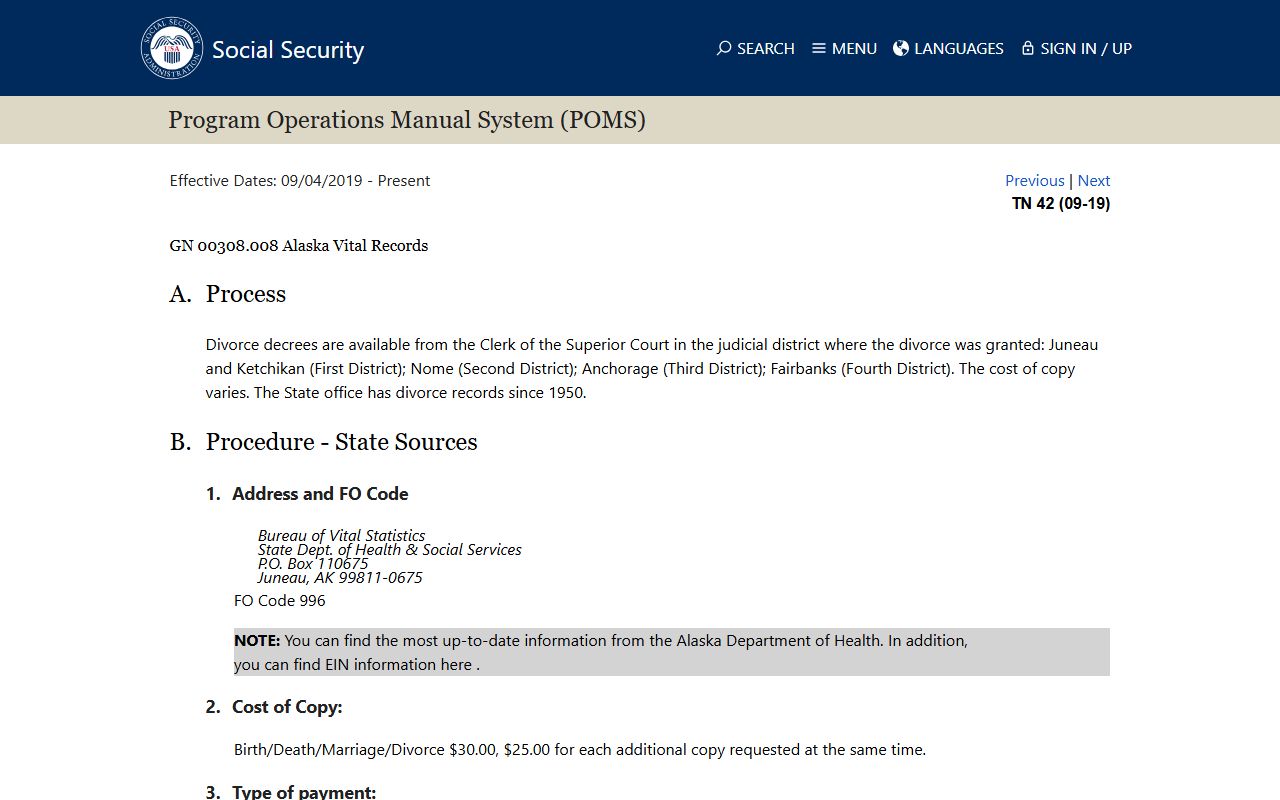
The SSA Program Operations Manual System covers how federal agencies use Alaska divorce and dissolution records, including which judicial district has jurisdiction in each region and what proof documents are accepted.
Self-Help and Legal Resources in Alaska
The Alaska Court System Family Law Self-Help Center is a free resource for people who handle their own dissolution or divorce case. The helpline number is (907) 264-0851 in Anchorage or toll-free (866) 279-0851 for residents outside Anchorage. Staff can answer questions about forms and court procedures. They cannot give legal advice. The center also runs clinics for people who may qualify for a default divorce.
The Alaska Bar Association publishes plain-language guides about the dissolution and divorce process for the general public. Alaska Legal Services Corporation provides free or low-cost legal help to people who qualify based on income. They work on family law cases including dissolution of marriage, custody, and support. Court clerks can provide forms and explain procedures but cannot give legal advice under state rules.
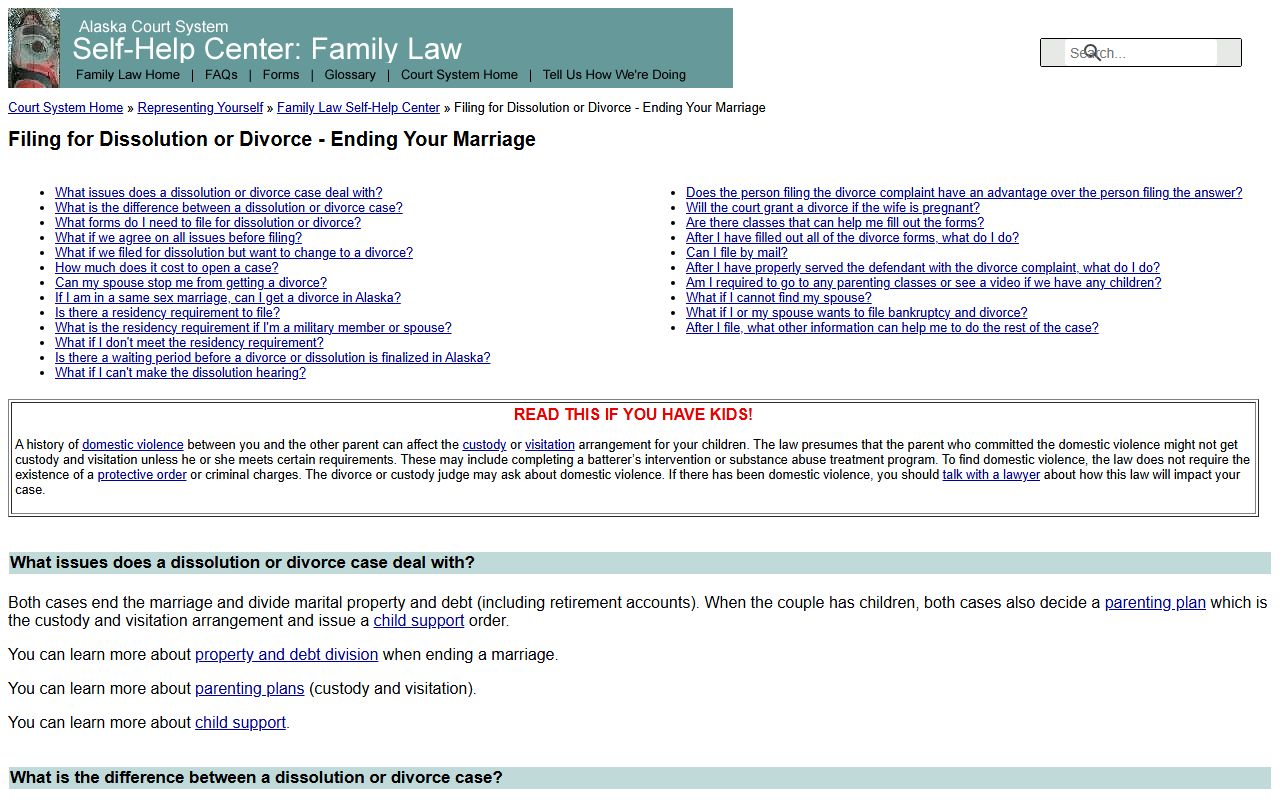
The Family Law Self-Help Center provides guides, forms, and a helpline for Alaskans navigating dissolution of marriage cases on their own, covering everything from which packet to file to what to expect at the court hearing.
Browse by Borough or Census Area
Each Alaska borough and census area files dissolution of marriage cases at the Superior Court level. Select a borough below to find the courthouse address, contact information, and local resources for dissolution records in that area.
View All 30 Alaska Boroughs & Census Areas
Dissolution of Marriage Records in Alaska Cities
Residents of Alaska's major cities file dissolution cases at the Superior Court serving their borough. Select a city below to find the courthouse, contact details, and step-by-step guidance for dissolution of marriage records in your area.